


Increasing attention plays an important role in a child’s success in the classroom. Attention allows children to “tune out” unrelated information, background noise and visual distractions. By doing this children are able to concentrate and focus on the important information being given by teachers. The overall goal is to make all learning experiences full of sensory information so that there are maximum opportunities to notice and respond to the cues in the environment, as well as teach a child to pay attention.
 Provide opportunities for movement and change to alert the senses. Change position in class, i.e. move to a different chair, or change body position i.e. sitting at table, lying on tummy on floor, sitting on carpet, use an air filled cushion, etc.). A child may require direction to move or change position as they may not realise they need to move or seek this for themselves.
 Chewing gum or chewy sweet will provide strong proprioceptive input than can compete with external noises and calm the nervous system. Fidget toys may help for same reason e.g. balloon toy, koosh ball, rubber band. Fidget toys can be used on a key ring to make them more discreet.
You may be surprised at the different ways you can alter a person’s “arousal” level (e.g. his concentration/relaxation/activity levels).
Certain activities or environmental stimuli can be used to stimulate your child and improve his concentration; other strategies can be used to calm him down. The following table may give you some ideas – chose ones to try which are appropriate given your child’s age and needs.
Self-regulating techniques that can be both calming and alerting in the classroom:


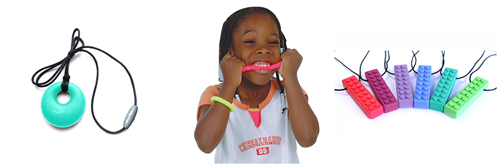 Chewing or sucking on food items or Chewellery.